
Noir films such as Double Indemnity, and Neo-noir films including Chinatown and Devil in a Blue Dress, illustrate the different themes and film techniques that are represented by the noir genre.
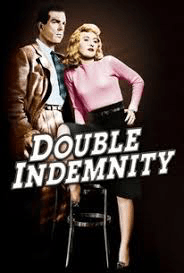
Double Indemnity had a unique set-up in comparison to the other films. From the first scene, viewers already know what has happened: Walter confesses on an office dictation machine that Barton was correct in believing that the accident was a murder. In fact, Walter admits to doing it for “money and a women”, which failed miserably. Now that viewers are fully aware as to who is responsible for this so-called murder, they watch the film with an outer perspective, watching the story unfold. Further, audience members see different elements of noir come up consistently throughout. There is of course a male detective who attempts to uncover this “accident”, yet always seem unsuccessful. Additionally, an alluring women, Phyllis, uses her sensuality toward Walter to plot out a way to kill her husband, with intentions to receive heaps of money.
“Because the guy you were looking for was too close. Right across the desk”
In the very last scene, Walter asks his best friend/boss to give him time as he escapes over the border, but soon his legs give out and he collapses.
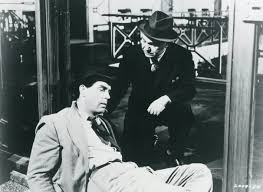
From this one scene, viewers see noir topics of smoking, black and white high contrast, and a sense of pessimism as the main character dies. Yet, it’s arguable to say that the “no happy endings” element of noir may not have held true in this film. Specifically analyzing the concept of smoking, at the very end Keyes lights Walter’s cigarette and tells him “Closer than that, Walter”. Walter proceeds to say, “I love you too”. Audience members already knew from the very beginning that Walter’s destiny was not looking up. Surprisingly though, the film ended with a twist; it turned upward, in a bitter sweet, more positive ending. Keyes and Walter remain loyal to one another and illustrate their incredibly strong friendship in the last scene as Keyes’s light his cigarette and they share their final words with one another.
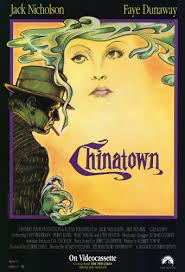
Chinatown, on the other hand, begins with a fully zoomed-in shot of photos of a man and women having sex, with no context mentioned. Soon, the camera zooms out and viewers learn that these are photographs. As illustrated from this very scene, unlike Double Indemnity, viewers have no idea as to what’s happening. They must wait for the camera to zoom out to realize that those images were photographs; they must sit tight and be disoriented/thrown off at times, as they follow along the mystery from Gittes’s point of view. Considering the noir elements of this film, viewers see the use of male detectives, smoking, and corruption. Diving deeper into the neo-noir elements, there was a shift to the sociological horrors faced during the time period. There was little focus on someone “going crazy” or being “mentally insane” and rather discussion about the world around the characters and systemic evils that existed at the time. Jake attempts to uncover this conspiracy but continues to get shut away because the people responsible are in such high power.
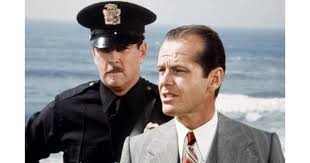
When Jake was asked what he does for the police, he responds “as little as possible”. Later in the movie, Eveyln is killed, and Escober says to turn them all loose, releasing Noah Cross from his land scheme and murder of Horace Mulwray.
Jake speaks the incredibly famous quote, “Forget it, Jake. It’s Chinatown”.
Jake comes to terms that one can’t change things in this world, especially when something is rooted so deeply into the system. Everything is for the most part, predetermined, which is common in noir. Jake accepts that he can’t control or change the futility, injustice, and darkness that hides in the depths of the system of society.
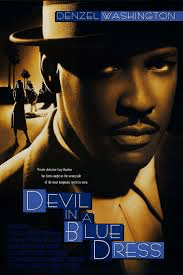
Lastly, A Devil in a Blue Dress, brings in a completely new element of neo-noir, different from the previous two films: Race. Around the 40s, there were very few African American roles, and those who were lucky enough to land a role, played servants/slaves/cooks/performers with very stereotypical representations. A Devil in a Blue Dress “documented” the invisible black film world to the public. Though, It’s saddening to analyze how main character Easy Rawlins’s behaviors and attitudes were changed in different settings. For example, when he’s driving around his own neighborhood, he’s joking around with his friends, laughing.
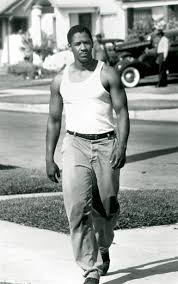
When driving with Daphne in the passenger seat, in an old white neighborhood, viewers immediately see a shift in his body language. He suddenly turns fearful, tense, and focused. After Daphne asked if he was nervous, Easy responds, “I’m not scared, I’m stupid”. Any big gestural movement or hint of being a threat, Easy could immediately be arrested, even killed. Although it’s extremely disheartening to watch scenes like these, it’s essential to understand this racial tension that persisted years ago and consider how it has changed or developed over the years.
The urban landscape of Los Angeles plays a central role in each of the films. In Double Indemnity, the plot always seemed to thicken while in some form of transportation. Such as, when driving in the car, Walter chokes Mr. Dietrichson to death. In Chinatown, Los Angeles takes on a very pessimistic role. LA is described as a desert, with water over it; water resembles power and whoever has control of it, subsequently has the money and power in society. Viewers see violence and corruption that is unavoidable and inevitable because of the way society is set up due to the landscape of Los Angeles. For a Devil in a Blue Dress, different environments, whether being at his house in his neighborhood surrounded by other African Americans or in a predominantly white areas, Easy had to conform into different identities for his own safety.

We can read the city as a central character in the films because although Los Angeles is a singular place, one that doesn’t significantly change everyday, it plays a completely different role in each film. While watching these films we must ask ourselves questions about LA such as the following: what does it look like, how does it affect the plot? Once we actually think about Los Angeles as a living breathing real-life creature, we are able to read it as such.
 Alexis Livin' Life in Los Angeles