
Producers recently have been leaving the heart of downtown Los Angeles to film elsewhere. Locations such as Atlanta now offer major benefits such as state-of-the-art studios or tax breaks, saving producers millions. Yet, some elements and architectural structures cannot be replicated. Places like the Bradbury Building are remarkable, one-of-a kind structures, that are essential to the core plots of so many films.
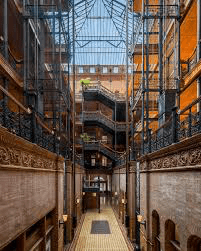
Ridley Scott’s decision of filming in the Bradbury Building, the location where JF Sebastian lived, was quite significant to the film and storyline. Not only did it act as the creepy, spacious home of the toymaker but also the location for the final battle scene between Rick and Roy.
Although opened in 1893, the Bradbury building was made to resemble a futuristic (specifically for the 2000s), blend of styles, with seemingly endless levels. In fact, the architectural design was directly inspired by the novel, Looking backwards, quoted as a “vast hall, full of light”. In Blade Runner, the building seemed to reflect the original intent/idea the architect had for the Bradbury. The magical, innovative concepts are presented within the walls of the building such as with the walking/talking/moving toys and shafts of light shooting through the glass ceilings. Similar to how the building was originally constructed to resemble this futuristic life, Blade Runner was created around this same concept of living in an advanced society consisting of flying cars and genetically engineered replicants.
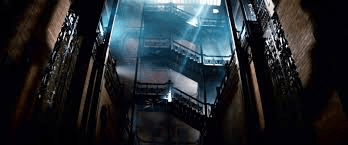
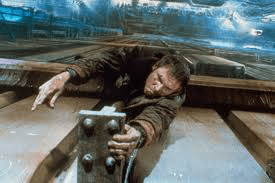
Considering the visual aesthetic of the way the film was shot, several of the scenes were extremely vertical, more than what we have seen before. By specifically shooting in the Bradbury, the scenes were able to conform to this vertical template of the rest of the movie. Further by shooting in this building, the producer was able to utilize several other interesting angles, that provoked different moods and feelings for the viewer. For example, in the final battle scene at the end, the replicant Pris continuously cartwheels and flips toward Rick Deckard. Because the building is so spacious horizontally, the shot is taken from Rick’s perspective; it appears as though she is cartwheeling right at us, which creates instant tension and fear for the audience. When shooting at a vertical shot, and very little is happening, the audience quickly feels suspense, knowing something is going to happen just by the eerie intense shot.
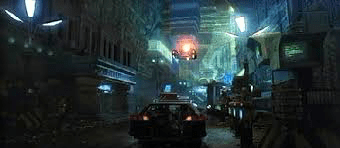
The building functions as this antiquated, outdated, space yet as described earlier, Blade Runner plays around this futuristic aesthetic. From the outside of the building it appears as this dusty old, grimey, brick office building. Similar to how when you walk around the streets of this city created in the film, there are fires, violence, large crowds, and an inner-city way of life. Yet, when one steps inside, the dust, moving toys, glass ceilings, bands of light, and endless layers now all seem magical; almost like you step into a completely new world. This magical, eerie feel portrayed inside the building perfectly suits the futuristic aesthetic of the flying cars and wealthy colonies living at the top. Analyzing this contrast between this inner-city run-down life (outside of the Bradbury) compared to the futuristic, flying cars, magical, off-colony world (inside the Bradbury) is remarkable.
Whether being portrayed as a Chocolate Factory for Twix commercials or an office in 500 Days of Summer, the Bradbury Building is a stunning piece of architectural design that simply cannot be remade. Whether modern, upscale, haunted, futuristic, the various elements inside the building such as the iron work and open balconies, truly make it a place of boundless opportunity.
 Alexis Livin' Life in Los Angeles